


Palestinian Athlete Yousef Hussein Just Ran from Abu Dhabi to Doha
Over the course of twelve days, Yousef Hussein ran the equivalent of a full marathon everyday, traversing borders and deserts.
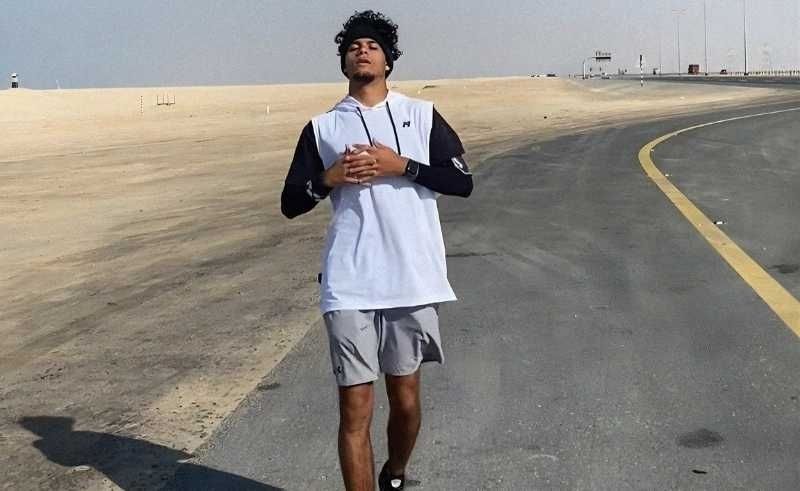
On the second-to-last day of his run, which had taken him through the deserts of Arabia and across three national borders, Yousef Hussein found himself on the edge of Doha as a sandstorm began rolling in. He had already been running the equivalent of a full marathon every single day for the past ten days, and now the wind was pushing its full force against him, requiring twice his usual strength just to keep moving forward.
With sand pelting his eyes and mouth, he was flagged down by curious cars, asking what he was doing, if he needed a ride, and whether he had enough water. If the thought “Why am I doing this?” had ever crossed his mind, he could at least take comfort in the fact that his destination was finally in sight: the glittering cityscape of the Qatari capital city, a world away from the desolate highways and shifting sand dunes that had been accompanying him on his journey.
Hussein, a 24 year-old athlete from Palestine who is currently completing his Master’s Degree in Business Management Engineering at Emirates Aviation University in Dubai, set out from Abu Dhabi on January 14th, 2026, running 480 kilometres to his destination, Doha. Just two years prior, he had run from Dubai to Saudi Arabia, covering over 400 kilometres in nine days despite having gone through multiple knee surgeries, which left us wondering: why? And, perhaps more importantly, why again?
We caught up with Hussein the day after he finished his run to ask him these burning questions, and a whole lot more.
Yousef, now that you’ve just finished your incredible run, how do you feel?
Well, first off, I never want to do something like this again. But that’s what I said last time, so who knows.
But, I mean, imagine you’ve been alone in the desert for two weeks, away from civilisation, sleeping in the worst possible places. When I was done, it didn’t feel real. It felt like I was going to wake up the next day, and do it all over again. It only hit me the next day, at the festival.
What’s this festival?
A few days before I reached Doha, ‘Match For Hope’ messaged me. They were organising a charity match in Qatar with football legends and a Fan Festival for charity, so they invited me to join. They took me backstage and I got to meet the director of the event, and even got to hang out with some of my favourite YouTubers, KSI and Chunkz.
But that’s not why you set out to run in the first place.
Not at all.
So why did you run?
I was a runner in high school and during university. But then, I tore my ACL three times and had multiple knee surgeries. For me, this run was about proving that although these setbacks happened, I could still do it. In the end, it’s really up to you to decide if you want to move forward with your life or stay in the same place.
What was a typical day like on the road in the UAE?
I would start at 3:30 PM and run for 20 kilometres straight. Then, my support driver would meet me, park on the side of the road, and I would eat an energy gel, sit down a bit, and work on editing my videos. After that, I’d do another 10 kilometres, rest for another half hour, then another 10 kilometres after.
At the end of each day, the support car would take me to whatever I was staying, and the next day it would drop me where I left off, and I’d continue running again. The only other times I would get into the car is if we were crossing a border, and to catch Friday prayer at a mosque.
And in Saudi?
There were no lampposts on the highways, so I didn’t want to run at night. That meant I had to start at 12:30 PM and run for about 5-6 hours every day.
The sand dunes there were also a lot more dangerous, sometimes getting onto the road and forcing me into the path of the trucks, which were coming from behind me.
 How’d you keep the energy up?
In my last run, two years ago, I would begin running in the early morning. But I realised that I would have much more energy if I ran in the afternoon, because then I could get a proper meal in. So, at least two hours before running, I would have breakfast.
Is this kind of adventure usual for you? Were you like this in high school?
Well, I’d say I’m a pretty cool guy [laughs].
In high school, I was really good at middle distance and I really wanted to go pro. But, when I tore my ACL during my first year of university, it became insanely difficult. I tried to get back into running afterwards, but then I tore my ACL again. And then I tore it a third time. So now middle distance is out of the question, because it means sprinting for a long time. It’s impossible for me to reach my top speed.
But honestly, nothing for me has ever been just casual. Sports, education, whatever it is, I can’t not give it my all. So, that’s how I got the nickname “try-hard.”
Were you worried these injuries would resurface?
Not really. I trained really hard before this run. I would run half marathons almost everyday around my neighbourhood and run them at fast paces. I made sure I was ready.
But still, running the equivalent of a marathon everyday for twelve days straight must have been challenging, even for a try-hard.
It was one of the hardest things I’ve ever had to do. At the time I was planning it, it sounds like a good idea, like “This is going to be so cool!” and “The rewards are going to be amazing!” But when you actually do it…
For two weeks straight, all I saw was desert. I was extremely tired, extremely lonely. I missed my family. I missed my friends.
How’d you keep the energy up?
In my last run, two years ago, I would begin running in the early morning. But I realised that I would have much more energy if I ran in the afternoon, because then I could get a proper meal in. So, at least two hours before running, I would have breakfast.
Is this kind of adventure usual for you? Were you like this in high school?
Well, I’d say I’m a pretty cool guy [laughs].
In high school, I was really good at middle distance and I really wanted to go pro. But, when I tore my ACL during my first year of university, it became insanely difficult. I tried to get back into running afterwards, but then I tore my ACL again. And then I tore it a third time. So now middle distance is out of the question, because it means sprinting for a long time. It’s impossible for me to reach my top speed.
But honestly, nothing for me has ever been just casual. Sports, education, whatever it is, I can’t not give it my all. So, that’s how I got the nickname “try-hard.”
Were you worried these injuries would resurface?
Not really. I trained really hard before this run. I would run half marathons almost everyday around my neighbourhood and run them at fast paces. I made sure I was ready.
But still, running the equivalent of a marathon everyday for twelve days straight must have been challenging, even for a try-hard.
It was one of the hardest things I’ve ever had to do. At the time I was planning it, it sounds like a good idea, like “This is going to be so cool!” and “The rewards are going to be amazing!” But when you actually do it…
For two weeks straight, all I saw was desert. I was extremely tired, extremely lonely. I missed my family. I missed my friends.
-bb520243-1cf4-43ed-a909-80ab83917016.jpg) At one point, I I was genuinely sick of hearing the sound of cars honking, sick of hearing the sound of wind. You know when it’s that throbbing sound inside your head? I hated it.
So how did you get through it? What did you do to pass the time?
At first I listened to music. But by day three or four, I grew sick of it. So I switched to podcasts and calling my family.
Then, I started listening to movie soundtracks, mostly anime, so I could be with my thoughts. I felt like I was the main character when I listened to those. Attack on Titan. Haikyu!!, Naruto. Also, How to Train Your Dragon.
But, eventually, I got sick of that, too.
What was the food situation like?
I didn’t have the luxury of choosing what to eat. It was always just what’s available. Sometimes I’d have a nice meal where I was staying. Other times, it was just roadside cafeteria food.
And you said you had a support driver?
Yes, masakeen (poor guys) [laughs].
In the first week, the support driver was a friend of mine, and in the second week it was my younger brother.
Mostly, they stayed in the car at the designated checkpoints and waited for me. Every ten minutes they checked on my live location to make sure I was still moving. Sometimes I would give them specific tasks, like getting electrolytes from a gas station if I felt particularly dehydrated.
Honestly, I really appreciated them. I also paid my friend for his time, since he’s a grown adult with a job and I was taking him out of his life, essentially. But I told them: I need you. I can’t run alone. And I was lucky they both said yes.
Did you have any sponsors?
I was looking for sponsors, but no I didn’t secure any. I contacted all these different brands. Some of them supported me, but they would not sponsor me. New Balance gave me the gear and the shoes, for example. ADNOC offered to pay for a few nights at a hotel near their headquarters in Abu Dhabi when I was making my way through there. Two years ago, they gave me an award for running across Abu Dhabi.
But, perhaps for political reasons, no one was willing to sponsor me. A week before I started my journey, I was warned by a lot of people not to do this run because it’s not a good idea due to the tensions that were flaring up in the region. But when people tried to talk me out of it, I told them I was still going to do the run.
Luckily, I had the support of my family, in Palestine and in Dubai.
And nothing got in your way?
First, I was worried about being stopped by the government or by police. It did happen, especially in Saudi, but in the end everyone was super helpful, thank God. But then, I started to worry about the weather.
On the day of that huge sandstorm, which was physically the hardest day, a lot of people offered me a ride and gave me water. I also got a lot of support on social media, which really helped me keep going, despite everything.
Did you ever think of giving up?
I had a lot of moments of regret during my first three days. At the 20 kilometre mark each day I would ask myself: “What did I get myself into?” You would think it would get better, the more time went on. But, unfortunately, since I had done something similar two years ago, I already knew it would not get easier. It would only get harder.
It was also frustrating to know that I could run faster, but shouldn’t. If I got fatigued, well, I’d still have to wake up the next day and run another marathon. And then I would be even more tired and sore. So, I had to take pace myself.
And you definitely won’t do this again?
Well…who knows? But, there’s this part of me that wants to move on with life. I want to get married, get a sustainable job, grow up. I feel like I’ve lived my dream, thank God. So, it might be time to get on with it.
At one point, I I was genuinely sick of hearing the sound of cars honking, sick of hearing the sound of wind. You know when it’s that throbbing sound inside your head? I hated it.
So how did you get through it? What did you do to pass the time?
At first I listened to music. But by day three or four, I grew sick of it. So I switched to podcasts and calling my family.
Then, I started listening to movie soundtracks, mostly anime, so I could be with my thoughts. I felt like I was the main character when I listened to those. Attack on Titan. Haikyu!!, Naruto. Also, How to Train Your Dragon.
But, eventually, I got sick of that, too.
What was the food situation like?
I didn’t have the luxury of choosing what to eat. It was always just what’s available. Sometimes I’d have a nice meal where I was staying. Other times, it was just roadside cafeteria food.
And you said you had a support driver?
Yes, masakeen (poor guys) [laughs].
In the first week, the support driver was a friend of mine, and in the second week it was my younger brother.
Mostly, they stayed in the car at the designated checkpoints and waited for me. Every ten minutes they checked on my live location to make sure I was still moving. Sometimes I would give them specific tasks, like getting electrolytes from a gas station if I felt particularly dehydrated.
Honestly, I really appreciated them. I also paid my friend for his time, since he’s a grown adult with a job and I was taking him out of his life, essentially. But I told them: I need you. I can’t run alone. And I was lucky they both said yes.
Did you have any sponsors?
I was looking for sponsors, but no I didn’t secure any. I contacted all these different brands. Some of them supported me, but they would not sponsor me. New Balance gave me the gear and the shoes, for example. ADNOC offered to pay for a few nights at a hotel near their headquarters in Abu Dhabi when I was making my way through there. Two years ago, they gave me an award for running across Abu Dhabi.
But, perhaps for political reasons, no one was willing to sponsor me. A week before I started my journey, I was warned by a lot of people not to do this run because it’s not a good idea due to the tensions that were flaring up in the region. But when people tried to talk me out of it, I told them I was still going to do the run.
Luckily, I had the support of my family, in Palestine and in Dubai.
And nothing got in your way?
First, I was worried about being stopped by the government or by police. It did happen, especially in Saudi, but in the end everyone was super helpful, thank God. But then, I started to worry about the weather.
On the day of that huge sandstorm, which was physically the hardest day, a lot of people offered me a ride and gave me water. I also got a lot of support on social media, which really helped me keep going, despite everything.
Did you ever think of giving up?
I had a lot of moments of regret during my first three days. At the 20 kilometre mark each day I would ask myself: “What did I get myself into?” You would think it would get better, the more time went on. But, unfortunately, since I had done something similar two years ago, I already knew it would not get easier. It would only get harder.
It was also frustrating to know that I could run faster, but shouldn’t. If I got fatigued, well, I’d still have to wake up the next day and run another marathon. And then I would be even more tired and sore. So, I had to take pace myself.
And you definitely won’t do this again?
Well…who knows? But, there’s this part of me that wants to move on with life. I want to get married, get a sustainable job, grow up. I feel like I’ve lived my dream, thank God. So, it might be time to get on with it.
-46fb4ffd-bf78-4d3b-ade8-055e48df8336.jpg) So, at the end of all this, what did you learn?
I definitely learned just how resilient the human body can be. I was honestly shocked some days when I had just finished a marathon and thought: “This is actually doable. I can actually make it happen.”
Every day, I pushed myself and found that my limits were much further than I thought. In the end it really is the mind that holds you back, not the body.
So, at the end of all this, what did you learn?
I definitely learned just how resilient the human body can be. I was honestly shocked some days when I had just finished a marathon and thought: “This is actually doable. I can actually make it happen.”
Every day, I pushed myself and found that my limits were much further than I thought. In the end it really is the mind that holds you back, not the body.
- Previous Article Torasna & Brassbell to Reimagine 500 Heritage Stays Across Egypt
- Next Article Morocco's Lavish Bahia Palace Upholds Forgotten Narratives
Related Articles
Trending This Month
-
-

-
-
 Oct 02, 2026