

The Couple Making Room for Travelers in Alexandria's Forgotten Corners
After years flipping homes in the US, Samar El Kot and Ahmed Mattar are transforming overlooked corners of Alexandria into distinctive guest homes, making a case for the city beyond postcards.

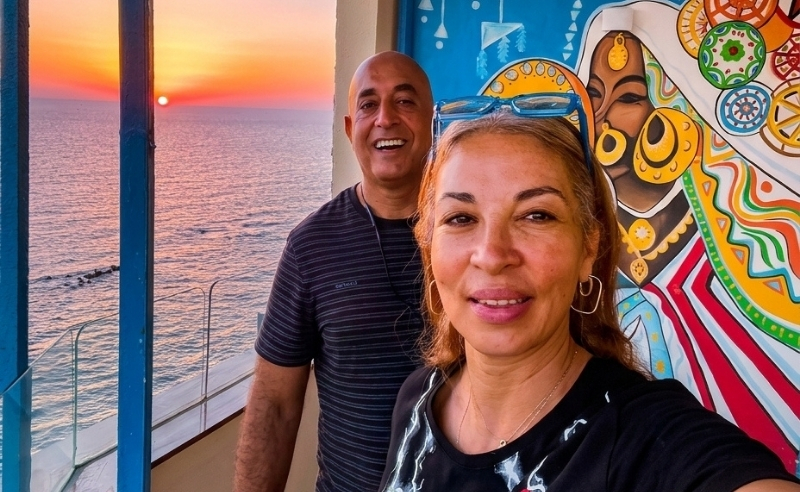
Years before Airbnb reached Alexandria, Ahmed Mattar was already renting rooms out to guests.
He and Samar El Kot had spent the better part of a decade in the United States, buying houses, fixing them up and selling them on, a dozen times or more, purely because they liked doing it.
When they moved back to Egypt and Airbnb started catching on in 2010, Ahmed stood in an empty flat in San Stefano and ran the numbers: a few hundred pounds a night beat four thousand a month for a proper let.
"We didn't realise it when we were flipping homes," Samar says, laughing at her younger self. "We thought we were just doing it."
Some households run on that instinct without ever naming it. The one Ahmed and Samar keep outside Alexandria is one of them, a rambling place where their friend Amer sits through entire conversations chipping in with footnotes, and where their sons and daughters drift in and out with friends and wives in tow.
Ahmed holds court from an armchair, very clearly his armchair, angled to survey the living room, the terrace and anyone attempting to interrupt him mid-sentence. The labour has always split cleanly between them, though never on paper.
Ahmed is the hospitality engine, a man who cut his teeth in restaurants, where one bad review could erase a month of goodwill, and who still treats a guest's comfort as a daily reckoning.
Samar, an architect by training and in practice, decides what a space is for. A maximalist in a minimalist world, turning a mirror that should have been junk into a headboard.
Together they pick through the city's neglect, a derelict Manshiya walk-up, a crumbling Bahari facade, a plywood shack on a rooftop, and turn them into places that make people fawn over the view.
The style of each of the apartments is born out of a stubborn theory of beauty. San Stefano, the first one, came out clean and sensible, "the old style."
Manshiya came next, and Samar was not so sure. "Manshaya? What is this Manshaya for us?" was her verdict before she'd even seen the place, and Ahmed still finds it funny enough to do the voice. She went anyway, stood over the water, and changed her mind before the visit was over.
"When I went and I saw the view, how breathtaking it is, I was sold," she says, and then, almost sheepishly, admits to missing the very things that had put her off. "I now love coming to this area and walking in it, despite the mountains of dirt. When I was in America, I was missing the dirt, and the hustle and bustle."
Two flats went up there. One became Arabian Nights, its ceiling pressed with fretwork by craftsmen normally hired to line tents for weddings, its bathroom tiled blue and white to a Moroccan pattern Samar sourced from memory.
An old mirror, due to be thrown out before the renovation, survived because she couldn't bring herself to lose it. "I like to repurpose," she says, and the mirror is a headboard now, repainted, doing a completely different job.
The other Manshiya flat, Nubian Village, went entirely to the man who had painted the walls of Anacato, the small Nubian hotel where Ahmed and Samar once stayed, domes and doorways done in colour.
They tracked him down and asked for the same treatment. He cannot read or write. He moved in and stayed two months, building three-dimensional plaster reliefs by hand across every wall, door and ceiling, raised out of the surface rather than painted onto it. When he finished, they painted the fridge orange to match.
"The foreigners are now taking pictures with the door. We have a Nubian door. They always take selfies with it," Ahmed says.
"I hate the idea of everything being super smooth," Samar says. "The moment all the surfaces are the same, it doesn't have a soul. I'm a hoarder. I want my travels on my shelves. I want to see the things that are part of me, around me."
Their newest build, a wooden cabin on a rooftop over Stanley Bridge, was made from tazana, the cheap waterlogged formwork timber used to pour concrete on nearly every construction site in Egypt and thrown out once the job is done. Ahmed had it taken apart, as he puts it, "like Lego," then rebuilt, left deliberately unsanded.
Two of their flats sit 18 and 19 floors up a tower angled across a 270-degree sweep of coastline towards Qaitbey Citadel, so precisely that an old photograph on Samar's phone, taken long before any of this existed, shows almost the same view her guests wake up to now. Each was meant to hold three bedrooms, and Samar turned them into one.
"Everything else is put in the view," she says. "It's a picture frame."
The building sits in a district called Al Mazar, the shrine, named for the mosque the whole skyline bends around.
It is not, by any conventional measure, a fashionable postcode. Neither is Kom El Dakka, where Arabian Nights sits above a bin Samar swears is never empty, in a neighbourhood that also holds the crumbling, unmarked house where the composer Sayed Darwish once lived.
"Nobody comes to Egypt for Alexandria," Ahmed says.
"Foreigners get one night here, maybe two, so they search the sea and skip past everything without it." What they sell, in the least fashionable pockets of the city they can find, is the Alexandria that never got a postcard made of it, bin included.
Not every guest agrees to see it that way straight away. Arabs, they say, tend to arrive already braced.
"They know Egypt. They see a popular area and they think it's full of people and garbage, and they say no, no, no, cancel it, I don't want anything," Ahmed says.
Their answer is always the same: come up first, drink the welcome juice, decide afterwards. Most stay. A handful leave, usually women travelling alone, which Samar doesn't argue with, since walking up an unfamiliar street after dark is a different calculation for a woman than for anyone reviewing the listing from a desk.
One review still sticks with them years on, from a guest who marked them down for having, in his own words, too many buildings around the property.
Ahmed handles the neighbours, who don't always take kindly to guests of mixed nationalities and uncertain marital status coming and going through their stairwell. He also handles everyone else, a staff of twelve running off WhatsApp groups named for each flat, replying to guests faster, he says, than any restaurant he has ever booked a table at.
Together the properties now operate under one name, Alex Rento, a small in-joke of a brand for what started as one flat and a guess.
There is an earlier chapter still, if you let the conversation run long enough.
After San Stefano, Samar had been taking German lessons herself, doggedly, so she could keep pace with her daughter's schooling and actually understand her homework rather than nod along. Around the same time their sons left for university abroad and two guest suites upstairs went quiet.
Ahmed, who solves most problems by inviting more people into the house, had an idea: fill the empty rooms with German-speaking guests so his daughter would have someone at the breakfast table to practise on besides her mother.
"We made the best friends," Ahmed says. "People used to live with us. We still talk to this day."
Whether this counts as the actual beginning of the business or just a very good story that happened to arrive first is something the two of them still argue about, gently, and watching them fail to agree tells you more than either version does alone.
This is where the marriage shows itself: Ahmed wants to talk logistics, the handoff the moment a guest books, the entry code that resets between stays. Samar keeps pulling him back: "These are our secrets," she tells him.
"People don't need every detail of how we run this. Just the outline." He looks, briefly, like a man denied a good story, and glances at Amer for support, who offers none and laughs instead.
Twelve properties in, that argument is still going, and neither of them seems in a hurry to settle it. The beds still get stripped and remade the same day, every time. The code still resets between guests. Whatever they can't agree on, the work itself keeps saying yes.
- Previous Article Libya Lifts International Flying Restrictions After 11 Years