

This Hotel in Fez Was Once a 14th-Century Palace
A palace on the edge of Fez's medina began as a restaurant and slowly consumed the rest of the building, now offering a dozen suites, and a rooftop view that has watched the city for seven centuries.

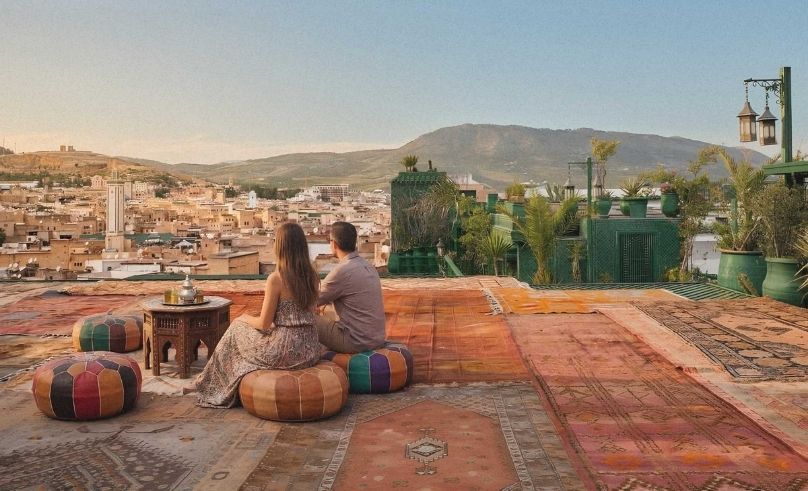
The terrace tilts toward the medina like a chair pulled up to a good story. Below, Fez spills across the hill in a landslide of limestone and terracotta, satellite dishes wedged between medieval finials, laundry lines strung from one courtyard to the next. The call to prayer rises from a minaret you cannot see, then another, then another, until the air hums with overlapping vowels. A donkey cart rattles up a cobbled lane somewhere beneath the green tiles of the balustrade. This is the view the Palais de Fès has guarded for seven centuries—give or take a few wars and a dynasty or two.
-4191ae24-1bb2-48ef-ad20-91fde4a90ba7.jpg) The palace began as a single 14th-century estate during the Marinid golden age, when Fez was the capital of a kingdom that stretched from the Mediterranean to the Sahara. It was divided among descendants, scattered like a deck of cards, then slowly reassembled by a man named Azzeddine Tazi, who spent thirty years buying back the pieces. He opened a restaurant in 1980, the first of its kind in the city, and raised his children in the rooms that would eventually become a hotel. When he died in 2019, his children Ghita and Nacer returned to Fez to sort through the estate. Walking through the building as adults for the first time, they saw their father's restaurant and the full architecture of his obsession. They decided to finish the job.
They renovated and opened the hotel fully in 2020, a year when most hospitality owners were locking their doors. They filled it with what they had learned abroad: service structures from Park Hyatt, training protocols from the Ritz-Carlton. But the bones remained. A reception hall with carved cedar ceilings, the wood darkened by centuries of cooking fires and cigarette smoke. An Andalusian courtyard with a central fountain, the water falling in a loop that never varies its pitch. Green zellige tiles on the walls, the colour of a lemon tree's deepest leaves, laid by hands that had never seen a continent to the west.
The palace began as a single 14th-century estate during the Marinid golden age, when Fez was the capital of a kingdom that stretched from the Mediterranean to the Sahara. It was divided among descendants, scattered like a deck of cards, then slowly reassembled by a man named Azzeddine Tazi, who spent thirty years buying back the pieces. He opened a restaurant in 1980, the first of its kind in the city, and raised his children in the rooms that would eventually become a hotel. When he died in 2019, his children Ghita and Nacer returned to Fez to sort through the estate. Walking through the building as adults for the first time, they saw their father's restaurant and the full architecture of his obsession. They decided to finish the job.
They renovated and opened the hotel fully in 2020, a year when most hospitality owners were locking their doors. They filled it with what they had learned abroad: service structures from Park Hyatt, training protocols from the Ritz-Carlton. But the bones remained. A reception hall with carved cedar ceilings, the wood darkened by centuries of cooking fires and cigarette smoke. An Andalusian courtyard with a central fountain, the water falling in a loop that never varies its pitch. Green zellige tiles on the walls, the colour of a lemon tree's deepest leaves, laid by hands that had never seen a continent to the west.
-455f4019-4b62-4a38-bc8f-c5fbc81f9034.jpg) Today, the hotel holds a dozen suites and a private riad. No two are alike. The Morjana, the Karima, the Jawhara—each named for a woman, each with its own temperature, its own light. One wears Hermès orange. Another a blue pulled from a Fassi fountain. The walls speak in handmade tiles and sculpted plaster, in woodwork that took a single artisan days to carve.
The restaurant, Dar Tazi, has not changed its menu in forty-four years. The kitchen staff have worked there for most of their lives. They learned from the cooks who learned from the cooks before. Meals unfold across multiple settings: the formal interior spaces, a terrace edged with greenery, quieter corners where a table can feel momentarily isolated from the rest. The tagines arrive with the lid still on, and when the lid lifts, the steam carries preserved lemon, saffron, and the patience of hours.
Today, the hotel holds a dozen suites and a private riad. No two are alike. The Morjana, the Karima, the Jawhara—each named for a woman, each with its own temperature, its own light. One wears Hermès orange. Another a blue pulled from a Fassi fountain. The walls speak in handmade tiles and sculpted plaster, in woodwork that took a single artisan days to carve.
The restaurant, Dar Tazi, has not changed its menu in forty-four years. The kitchen staff have worked there for most of their lives. They learned from the cooks who learned from the cooks before. Meals unfold across multiple settings: the formal interior spaces, a terrace edged with greenery, quieter corners where a table can feel momentarily isolated from the rest. The tagines arrive with the lid still on, and when the lid lifts, the steam carries preserved lemon, saffron, and the patience of hours.-2034d07e-5e5c-4774-9016-96f59627b1fa.jpg) Some evenings extend beyond the expected format of dinner. On the rooftop, the 1001 Nights Dinner Experience rearranges the evening. Carpets laid out in deep reds, a table set at the centre of a carefully framed horizon. A live musician plays Arabic love songs for two people and the sky. The Atlas Mountains turn purple in the distance. The menu is the same one served to presidents and royals and anyone else who has found their way up these stairs. The meal follows a dégustation structure, each course placed with precision, though the atmosphere resists formality.
Some evenings extend beyond the expected format of dinner. On the rooftop, the 1001 Nights Dinner Experience rearranges the evening. Carpets laid out in deep reds, a table set at the centre of a carefully framed horizon. A live musician plays Arabic love songs for two people and the sky. The Atlas Mountains turn purple in the distance. The menu is the same one served to presidents and royals and anyone else who has found their way up these stairs. The meal follows a dégustation structure, each course placed with precision, though the atmosphere resists formality.
-8baa3b75-478e-4aab-a966-c2de022a8b9e.jpg) Yet, perhaps the truest experience at Palais de Fès is finding the Hanging Gardens at the hour when the sun has softened to amber and the medina begins to light itself from within, window by window, courtyard by courtyard. The call to prayer rises again, and this time you recognise the intervals between the notes. A donkey cart fades into a side street. The fountain in the Andalusian courtyard continues its endless, unchanging syllable. The palace has been standing here for seven centuries. It will be standing here tomorrow. And you, for a few hours, have been part of its watching.
Yet, perhaps the truest experience at Palais de Fès is finding the Hanging Gardens at the hour when the sun has softened to amber and the medina begins to light itself from within, window by window, courtyard by courtyard. The call to prayer rises again, and this time you recognise the intervals between the notes. A donkey cart fades into a side street. The fountain in the Andalusian courtyard continues its endless, unchanging syllable. The palace has been standing here for seven centuries. It will be standing here tomorrow. And you, for a few hours, have been part of its watching.
- Previous Article Mandarin Oriental Rewrites the Legend of Old Cataract on the Nile
- Next Article We Explored Downtown Cairo Using Maps From 100 Years Ago