

The Unexpected Volcanic Worlds of the Middle East & North Africa
From Turkey’s crater lakes to Morocco’s volcanic massifs, MENA is full of landscapes shaped by fire, not just sand and sea.
In some parts of the Arab world, the ground abruptly shifts colour. Mountains darken into basalt. Lava fields stretch across the horizon in hardened waves. Craters appear without warning beside desert roads, while volcanic stone shapes entire villages and valleys.
From the vast harrat lava fields of Saudi Arabia to the crater lakes of eastern Turkey and the volcanic massifs of Morocco, these ancient geological worlds reveal landscapes formed by eruptions that once transformed the terrain from deep beneath the earth’s surface.
Harrat Khaybar — Saudi Arabia
-3331907f-d668-4075-8cc7-6f1babf0d4b2.jpg) Spreading across western Saudi Arabia, Harrat Khaybar is part of the Kingdom's vast volcanic lava fields known as harrat. The landscape is defined by black basalt plains, ancient lava flows, and unusual light-coloured volcanic domes that stand out sharply against the darker terrain. Stretching across hundreds of kilometres, it forms one of the most visually unexpected volcanic regions in the Arabian Peninsula.
Djebel Sirwa — Morocco
Spreading across western Saudi Arabia, Harrat Khaybar is part of the Kingdom's vast volcanic lava fields known as harrat. The landscape is defined by black basalt plains, ancient lava flows, and unusual light-coloured volcanic domes that stand out sharply against the darker terrain. Stretching across hundreds of kilometres, it forms one of the most visually unexpected volcanic regions in the Arabian Peninsula.
Djebel Sirwa — Morocco
-5f2017a9-1b8d-4c12-be0b-b8b99f519fc7.jpg) Located between Morocco's High Atlas and the Sahara, Djebel Sirwa is an extinct volcanic massif shaped by ancient eruptions. Its rocky slopes and dark stone formations rise above valleys known for saffron cultivation and traditional Amazigh weaving communities. In winter, snow occasionally settles on its volcanic peaks, creating a rare contrast between black rock and white alpine conditions.
Cappadocia — Turkey
Located between Morocco's High Atlas and the Sahara, Djebel Sirwa is an extinct volcanic massif shaped by ancient eruptions. Its rocky slopes and dark stone formations rise above valleys known for saffron cultivation and traditional Amazigh weaving communities. In winter, snow occasionally settles on its volcanic peaks, creating a rare contrast between black rock and white alpine conditions.
Cappadocia — Turkey
-7134c880-d084-4b61-b514-82b89a4a2961.jpg) Shaped by volcanic eruptions from nearby mountains such as Erciyes and Hasan, Cappadocia’s soft tuff rock slowly formed from layers of ash that solidified over millions of years. Wind and erosion carved these deposits into the region’s iconic “fairy chimneys,” while entire underground cities, churches, and homes were later carved directly into the volcanic stone, creating one of the world’s most surreal inhabited landscapes.
Waw an Namus — Libya
Shaped by volcanic eruptions from nearby mountains such as Erciyes and Hasan, Cappadocia’s soft tuff rock slowly formed from layers of ash that solidified over millions of years. Wind and erosion carved these deposits into the region’s iconic “fairy chimneys,” while entire underground cities, churches, and homes were later carved directly into the volcanic stone, creating one of the world’s most surreal inhabited landscapes.
Waw an Namus — Libya
-a679336a-69df-4989-8e33-bcbad6b163c2.jpg) Deep in the Libyan Sahara, Waw an Namus is a volcanic crater oasis surrounded by black ash fields visible in satellite imagery. At its centre lie small lakes and patches of vegetation that sharply contrast with the surrounding desert, creating one of North Africa's most surreal natural formations. Its name translates loosely to "Oasis of Mosquitoes," though visually it feels closer to a landscape from another planet.
Hoggar Mountains — Algeria
Deep in the Libyan Sahara, Waw an Namus is a volcanic crater oasis surrounded by black ash fields visible in satellite imagery. At its centre lie small lakes and patches of vegetation that sharply contrast with the surrounding desert, creating one of North Africa's most surreal natural formations. Its name translates loosely to "Oasis of Mosquitoes," though visually it feels closer to a landscape from another planet.
Hoggar Mountains — Algeria
-3c28750c-c882-4a18-99d5-d95143c50ab8.jpg) Rising from the heart of the Algerian Sahara, the Hoggar Mountains are the result of ancient volcanic activity that shaped dramatic peaks and dark basalt formations across the desert. Some of these formations are millions of years old, creating one of North Africa's most visually striking mountain landscapes. The region has long been associated with Tuareg communities and historic caravan routes crossing the Sahara.
Al Wahbah Crater — Saudi Arabia
Rising from the heart of the Algerian Sahara, the Hoggar Mountains are the result of ancient volcanic activity that shaped dramatic peaks and dark basalt formations across the desert. Some of these formations are millions of years old, creating one of North Africa's most visually striking mountain landscapes. The region has long been associated with Tuareg communities and historic caravan routes crossing the Sahara.
Al Wahbah Crater — Saudi Arabia
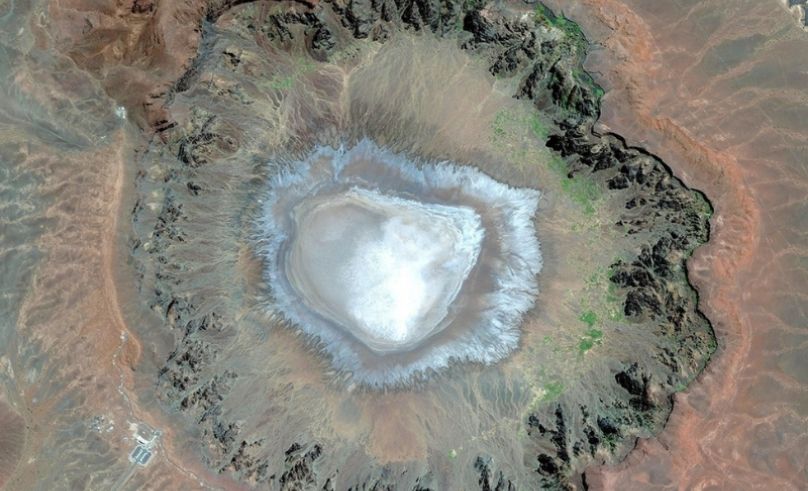
-14d111bc-0e60-4439-bba0-99461a07cb9b.jpg) Carved into the western Saudi landscape near Taif, Al Wahbah Crater is a volcanic maar crater formed by ancient volcanic activity interacting with groundwater. It stretches nearly 250 metres deep and over two kilometres wide, surrounded by dark basalt terrain, while its floor is covered in striking white sodium phosphate crystals visible from above. From the rim, the contrast between black volcanic rock and the bright crater basin creates a landscape that feels almost lunar.
Mount Nemrut — Turkey
Carved into the western Saudi landscape near Taif, Al Wahbah Crater is a volcanic maar crater formed by ancient volcanic activity interacting with groundwater. It stretches nearly 250 metres deep and over two kilometres wide, surrounded by dark basalt terrain, while its floor is covered in striking white sodium phosphate crystals visible from above. From the rim, the contrast between black volcanic rock and the bright crater basin creates a landscape that feels almost lunar.
Mount Nemrut — Turkey
-34f98c53-4cd4-479d-8d42-f88921194083.jpg) Located in eastern Turkey near Lake Van, Mount Nemrut is one of the largest volcanic calderas in the country. Inside its vast crater, the western half holds a deep blue lake while the eastern half is filled with hardened lava flows from ancient eruptions. Steep volcanic walls, hot springs, and solidified lava formations surround the caldera basin, creating an almost untouched geological world within it.
Harrat al-Sham — Jordan
Located in eastern Turkey near Lake Van, Mount Nemrut is one of the largest volcanic calderas in the country. Inside its vast crater, the western half holds a deep blue lake while the eastern half is filled with hardened lava flows from ancient eruptions. Steep volcanic walls, hot springs, and solidified lava formations surround the caldera basin, creating an almost untouched geological world within it.
Harrat al-Sham — Jordan
-19b81034-79d2-4bb7-b5f1-34bdae1a43e2.jpg) Stretching across Jordan, Syria, and Saudi Arabia, Harrat al-Sham is one of the largest volcanic fields in the Middle East. In northeastern Jordan, the landscape becomes a vast expanse of black basalt desert formed by ancient lava flows. Scattered across this terrain are archaeological desert kites and ancient stone structures, visible from above, revealing how early communities once interacted with this stark volcanic environment.
Stretching across Jordan, Syria, and Saudi Arabia, Harrat al-Sham is one of the largest volcanic fields in the Middle East. In northeastern Jordan, the landscape becomes a vast expanse of black basalt desert formed by ancient lava flows. Scattered across this terrain are archaeological desert kites and ancient stone structures, visible from above, revealing how early communities once interacted with this stark volcanic environment.
- Previous Article Algeria’s Hidden Caves Preserve 17,000 Years of History
- Next Article This Deserted Village Tells the Story of the UAE's Pearling Past