

The Last Dhow Builders of Oman's Sur Still Shape the Sea by Hand
In this port-side city in Oman, you can step into a factory where people are keeping the ancient dhow boat alive.

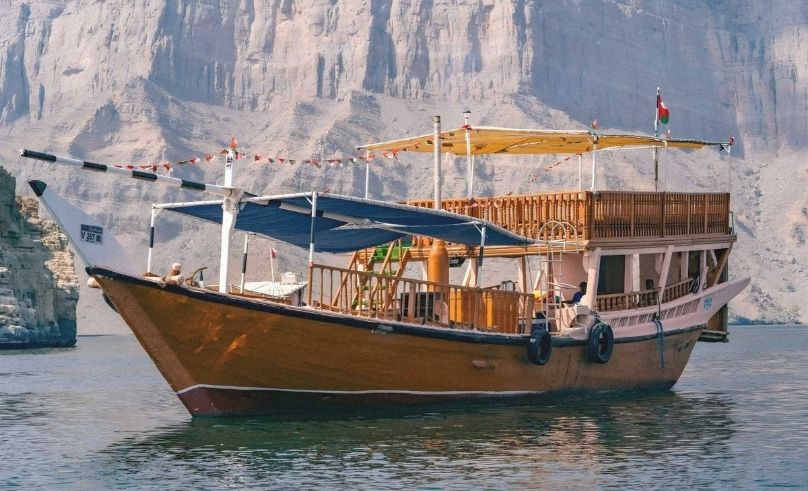
Before the world ran on oil, we ran on wind. We shaped wood into wings and gave them to the sea. There are men in Oman who still remember how to harness it—and they are one of the last.
Sur, a port city on Oman’s eastern tip, has been a hub of global trade for over a thousand years. By the sixth century, it was already a vital link between the Gulf, India, and the East African coast. At the centre of this trade was the dhow: a lateen-sailed wooden vessel that has been sailing the Red Sea and Indian Ocean for over 2,000 years. Within its hull travelled frankincense, ivory, pepper, and precious stones. Today, Sur is home to the last remaining dhow factory in Oman, where you can still watch craftsmen shape timber by hand using techniques that have remained unchanged for centuries. In its small museum, you can even walk away with a miniature. -71fdd62a-1ec2-425a-a741-cca2c3af0ca6.jpg) The dhow itself is not a single type of ship but a family of them—a generic name for the traditional wooden sailing vessels of the Indian Ocean and Red Sea, distinguished by their long, elegant hulls and triangular lateen sails attached to a crossbeam. They can be traced back to 600 BC, with origins disputed between India and the Arabian Peninsula. In practice, however, the dhow was a fusion of both these worlds: most were built from Indian teak, with sails woven first from coconut and palm leaves, and later from cotton that arrived with Indian trade. What made them especially unusual was their construction—the hull planks were not nailed together but stitched; bound with coconut fibre rope, with gaps sealed by cotton soaked in coconut oil that expanded when wet. When passing through the Gulf of Hormuz in the 13th century, Marco Polo noted their stitched construction with some suspicion, unconvinced that something held together by rope could survive the open sea. It had, of course, been doing so for a thousand years before he arrived, and would continue to do so long after his death.
The dhow itself is not a single type of ship but a family of them—a generic name for the traditional wooden sailing vessels of the Indian Ocean and Red Sea, distinguished by their long, elegant hulls and triangular lateen sails attached to a crossbeam. They can be traced back to 600 BC, with origins disputed between India and the Arabian Peninsula. In practice, however, the dhow was a fusion of both these worlds: most were built from Indian teak, with sails woven first from coconut and palm leaves, and later from cotton that arrived with Indian trade. What made them especially unusual was their construction—the hull planks were not nailed together but stitched; bound with coconut fibre rope, with gaps sealed by cotton soaked in coconut oil that expanded when wet. When passing through the Gulf of Hormuz in the 13th century, Marco Polo noted their stitched construction with some suspicion, unconvinced that something held together by rope could survive the open sea. It had, of course, been doing so for a thousand years before he arrived, and would continue to do so long after his death.-f3eb9451-b7f5-423e-91e6-f87327cb0aa8.jpg) To truly understand the dhow is to understand a form of globalisation that preceded the word itself. For centuries, these vessels carried not only goods but ideas, languages, and religions across the Indian Ocean. The historian's concept of the Indian Ocean world—a vast, interconnected web of cultures stretching from the Horn of Africa to the shores of China—was largely built on the dhow, and therefore, Sur. This, unfortunately, included the slave trade. For over a thousand years, enslaved people were transported in dhow holds—from what is now Mozambique and Tanzania to the Arabian Peninsula—in numbers that remain difficult to fully account for. Muscat and Sur were among the principal departure ports.
That system lasted for centuries, until the opening of the Suez Canal in 1869 changed the life of the dhow overnight. The canal accelerated global trade in one direction while devastating it in another—large European steamships flooded the Indian Ocean routes, exempt from the taxes that burdened local dhow traders, and the long-distance commerce that Sur had built its identity around moved elsewhere. What had once been a city of eight or more active shipbuilding yards contracted, decade by decade, to one.
To truly understand the dhow is to understand a form of globalisation that preceded the word itself. For centuries, these vessels carried not only goods but ideas, languages, and religions across the Indian Ocean. The historian's concept of the Indian Ocean world—a vast, interconnected web of cultures stretching from the Horn of Africa to the shores of China—was largely built on the dhow, and therefore, Sur. This, unfortunately, included the slave trade. For over a thousand years, enslaved people were transported in dhow holds—from what is now Mozambique and Tanzania to the Arabian Peninsula—in numbers that remain difficult to fully account for. Muscat and Sur were among the principal departure ports.
That system lasted for centuries, until the opening of the Suez Canal in 1869 changed the life of the dhow overnight. The canal accelerated global trade in one direction while devastating it in another—large European steamships flooded the Indian Ocean routes, exempt from the taxes that burdened local dhow traders, and the long-distance commerce that Sur had built its identity around moved elsewhere. What had once been a city of eight or more active shipbuilding yards contracted, decade by decade, to one.
-969e266d-fda5-4d4c-8422-a4a248e3515c.jpg) Only briefly was the vessel brought back to the world's attention—after decades of near silence—when in the early 1980s, British explorer and author Tim Severin arrived in the city with an ambitious plan: to prove that the legendary voyages of Sinbad the Sailor were rooted in the real seafaring traditions of the Arab world. To do so, he commissioned a faithful replica of a ninth-century dhow and sailed it from Oman to China. Once the boat was built, he spent the next eight months sailing across a 2,000-year-old trade route on a boat predating the year 1 AD.
Only briefly was the vessel brought back to the world's attention—after decades of near silence—when in the early 1980s, British explorer and author Tim Severin arrived in the city with an ambitious plan: to prove that the legendary voyages of Sinbad the Sailor were rooted in the real seafaring traditions of the Arab world. To do so, he commissioned a faithful replica of a ninth-century dhow and sailed it from Oman to China. Once the boat was built, he spent the next eight months sailing across a 2,000-year-old trade route on a boat predating the year 1 AD.
Today, Sur’s last remaining dhow factory not only keeps this ancient vessel afloat, but also the mechanisms behind its craft. Within its workshop, the sounds you hear are ancient ones—the creaking of rope being pulled, timber being shaped by hand, and the rhythm of tools unchanged for centuries. Each boat takes up an average of nine months to build to completion, with a workforce of up to forty men. In their toolboxes, it would not be a surprise to find, instead of a mechanical drill, a traditional bow drill—a hand-operated tool relying simply on one’s hands and the power of friction.
-5b0c0f1c-e06d-4072-af22-bc52bcfff3a9.jpg) These blueprints have never been written down. They live in the hands of the men who build them—in muscle memory, in minds, and in judgment passed from father to son across centuries. Because of this, the keepers of Sur’s dhow factory are well aware that when the last builder dies, the blueprint dies with him. It is a vulnerability the factory knows well. In recent decades, factory after factory has closed down, as the sons of dhow builders leave their fathers’ craft to the past.
And yet, the factory does not exist only as a place of loss. It is also a place of continuity, where the craft still moves between hands in real time. Rope is still pulled tight against wood. Timber is still measured by hand. And nothing—not the pace, not the practice—has been accelerated to match the world outside.
These blueprints have never been written down. They live in the hands of the men who build them—in muscle memory, in minds, and in judgment passed from father to son across centuries. Because of this, the keepers of Sur’s dhow factory are well aware that when the last builder dies, the blueprint dies with him. It is a vulnerability the factory knows well. In recent decades, factory after factory has closed down, as the sons of dhow builders leave their fathers’ craft to the past.
And yet, the factory does not exist only as a place of loss. It is also a place of continuity, where the craft still moves between hands in real time. Rope is still pulled tight against wood. Timber is still measured by hand. And nothing—not the pace, not the practice—has been accelerated to match the world outside.