

How an Artist's Atelier Became Morocco's Most Charming Farm Retreat
Once the rural atelier of French painter Patrice Arnaud, Farasha Farmhouse has been renovated into a farmhouse hotel surrounded by olive groves, chickens, wildflowers and mountain views.

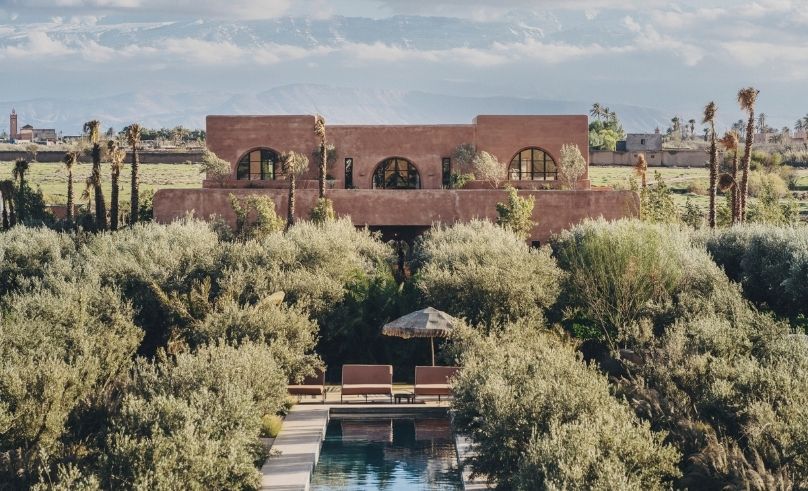
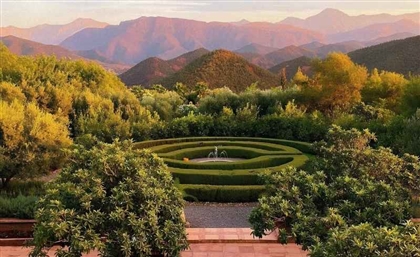
Thirty minutes outside Marrakech, the horizon stretches to where the Atlas mountains begin their pale ascent to the south. The Jbilet range mirrors them on the other side, and between the two, on a plateau, sits a low building the colour of the earth that made it: Farasha Farmhouse.
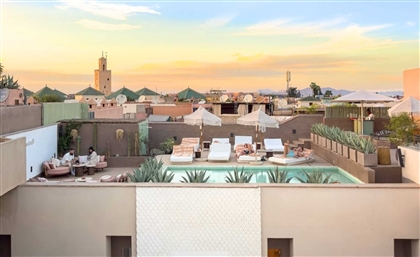
-2fd2578b-0926-460e-b2ba-07c4602e5b50.jpg) "When people arrive at the airport and the customs officer asks where they're staying and they say Farasha, the customs guys start giggling," Rosena Charmoy, co-founder of Farasha Farmhouse, shares with SceneTraveller. A low, earth-toned regenerative retreat half-hidden between wheat fields and olive groves, it spills across the land: herb gardens that feed the kitchen each morning, flowers cut and placed fresh into the farmhouse’s eleven rooms, chickens moving between shaded paths, and a fifty-metre pool that gathers the shifting light into a second sky held close to the earth.
"When people arrive at the airport and the customs officer asks where they're staying and they say Farasha, the customs guys start giggling," Rosena Charmoy, co-founder of Farasha Farmhouse, shares with SceneTraveller. A low, earth-toned regenerative retreat half-hidden between wheat fields and olive groves, it spills across the land: herb gardens that feed the kitchen each morning, flowers cut and placed fresh into the farmhouse’s eleven rooms, chickens moving between shaded paths, and a fifty-metre pool that gathers the shifting light into a second sky held close to the earth.
-d7092196-daa3-4400-a88c-5f60c1d8fa4d.jpg) The property was formerly the residence and atelier of French painter Patrice Arnaud, who had been using it as a private rural retreat. And by 2021, when Rosena and her husband Fred Charmoy bought it, the land had already grown tired. There were 350 olive trees, unwell and underfed, a derelict farmhouse, and that extraordinary geography. The Charmoys fell in love with it because the light was unlike anything they had seen, and because the view from the painter’s studio—now a suite called Leel—made a person want to stay very still and watch the sky change colour over the mountains. They had already spent nearly two decades in Morocco, running Boutique Souk, a high‑end events company that built parties for Chanel and Saint Laurent and Madonna’s birthday and Poppy Delevingne’s wedding. But they had always dreamed of owning a farm, and eating clean, and the people around them were hungry for something more organic and rooted in nature. So they started searching. "We were originally looking for something up high," Rosena says, "and then we actually realised that we really love this kind of ranch-style, very flat property, but framed by mountains on both sides. It gives it a very positive feng shui."
The property was formerly the residence and atelier of French painter Patrice Arnaud, who had been using it as a private rural retreat. And by 2021, when Rosena and her husband Fred Charmoy bought it, the land had already grown tired. There were 350 olive trees, unwell and underfed, a derelict farmhouse, and that extraordinary geography. The Charmoys fell in love with it because the light was unlike anything they had seen, and because the view from the painter’s studio—now a suite called Leel—made a person want to stay very still and watch the sky change colour over the mountains. They had already spent nearly two decades in Morocco, running Boutique Souk, a high‑end events company that built parties for Chanel and Saint Laurent and Madonna’s birthday and Poppy Delevingne’s wedding. But they had always dreamed of owning a farm, and eating clean, and the people around them were hungry for something more organic and rooted in nature. So they started searching. "We were originally looking for something up high," Rosena says, "and then we actually realised that we really love this kind of ranch-style, very flat property, but framed by mountains on both sides. It gives it a very positive feng shui."
-da0e6cf0-c6c1-483c-a827-8a5242f63e4b.jpg) They began with rejuvenating the land, and soon, butterflies started appearing in greater numbers, drifting through the fields and gardens. Rosena asked a friend for the Darija word: Farasha. A butterfly and—in the idiom of Moroccan flirtation—a term of endearment, the kind murmured to someone you are very much hoping to charm. “When we were renovating, we didn’t want to bring people from far away, so we recruited our immediate neighbours.” At least twelve of them now work on the farm, and the farm produces abundantly in return—a living ecosystem that increasingly feeds both itself and its guests. Herbs, lettuces and seasonal vegetables arrive directly from the gardens. Flowers grown on site fill bedrooms, restaurant tables and event spaces. The olive grove, now grown to more than five-hundred trees, yielded a record thousand litres of oil in this year's harvest. Bees produce fresh honey. Then the chickens—forty-five of them now—laying eggs each morning for the breakfast tajine. "You can taste it on the plate."
They began with rejuvenating the land, and soon, butterflies started appearing in greater numbers, drifting through the fields and gardens. Rosena asked a friend for the Darija word: Farasha. A butterfly and—in the idiom of Moroccan flirtation—a term of endearment, the kind murmured to someone you are very much hoping to charm. “When we were renovating, we didn’t want to bring people from far away, so we recruited our immediate neighbours.” At least twelve of them now work on the farm, and the farm produces abundantly in return—a living ecosystem that increasingly feeds both itself and its guests. Herbs, lettuces and seasonal vegetables arrive directly from the gardens. Flowers grown on site fill bedrooms, restaurant tables and event spaces. The olive grove, now grown to more than five-hundred trees, yielded a record thousand litres of oil in this year's harvest. Bees produce fresh honey. Then the chickens—forty-five of them now—laying eggs each morning for the breakfast tajine. "You can taste it on the plate."
-f7722264-bcbd-4cd0-8924-f8eb59b9f316.jpg) The plate, admittedly, has a great deal going for it. Farasha's kitchen is overseen by Executive Chef Aniss Meski. Casablanca-born, Montreal-formed, whose decade in Canada left him with the kind of cross-pollinated palate that makes farm-to-table cooking genuinely interesting. At Mouton Noir, his Marrakech restaurant (recognised, alongside Farasha, at the Best Chef Awards in Milan in 2025), Meski has long cooked with the same restless curiosity he brings to the farm table: kale Caesar with eggs from those same hens, broccoli tempura, roast pumpkin with sage and pomegranate, a daily tajine shaped entirely by whatever the garden is producing. The kombucha and ginger beer are fermented in-house. "We serve family style every day to our residents and to our restaurant guests and it's based on what's in the garden.”
The plate, admittedly, has a great deal going for it. Farasha's kitchen is overseen by Executive Chef Aniss Meski. Casablanca-born, Montreal-formed, whose decade in Canada left him with the kind of cross-pollinated palate that makes farm-to-table cooking genuinely interesting. At Mouton Noir, his Marrakech restaurant (recognised, alongside Farasha, at the Best Chef Awards in Milan in 2025), Meski has long cooked with the same restless curiosity he brings to the farm table: kale Caesar with eggs from those same hens, broccoli tempura, roast pumpkin with sage and pomegranate, a daily tajine shaped entirely by whatever the garden is producing. The kombucha and ginger beer are fermented in-house. "We serve family style every day to our residents and to our restaurant guests and it's based on what's in the garden.”-e899de7c-cb97-4027-818f-96b9c8294c83.jpg) As for Patrice Arnaud’s original atelier, it was reimagined in collaboration with Carmen Straatsma of Studio C in Ibiza—the couple spend summers in the Balearics, and their aesthetic has absorbed that particular island ease. They split it into two suites upstairs, added a garden‑facing double bedroom on the lower level, built a detached casita, and tied the whole thing together with an open‑plan lounge, dining area, bar and show kitchen. Over several years they scoured Marrakech's flea markets and antique dealers, gathering pieces slowly: vintage ceramics turned into lamps, mid-century furniture, handwoven textiles, objects carrying the gentle irregularities that come from having lived another life first.
Then, in February, Farasha opened the Ranch House: a collection of seven additional suites designed in collaboration with architect Idriss Karnachi of Studio Noss Noss. The new building contains four garden suites, each with its own terrace and private olive and palm gardens, and three rooftop suites whose sundecks look across the pool and straight at the mountains. Every room has a rug from Beni Rugs, the New York and Marrakech brand co‑founded by Tiberio Lobo‑Navia and Robert Wright, the latter now a partner in the farmhouse itself. The wool curtains, the sofa upholstery, the cushions, the towels, the blankets—all handwoven in Marrakech. The glasses are recycled local glass. “Everything is just made locally,” Rosena says. “It's a necessity in Morocco, and from that necessity is also pure luxury.”
As for Patrice Arnaud’s original atelier, it was reimagined in collaboration with Carmen Straatsma of Studio C in Ibiza—the couple spend summers in the Balearics, and their aesthetic has absorbed that particular island ease. They split it into two suites upstairs, added a garden‑facing double bedroom on the lower level, built a detached casita, and tied the whole thing together with an open‑plan lounge, dining area, bar and show kitchen. Over several years they scoured Marrakech's flea markets and antique dealers, gathering pieces slowly: vintage ceramics turned into lamps, mid-century furniture, handwoven textiles, objects carrying the gentle irregularities that come from having lived another life first.
Then, in February, Farasha opened the Ranch House: a collection of seven additional suites designed in collaboration with architect Idriss Karnachi of Studio Noss Noss. The new building contains four garden suites, each with its own terrace and private olive and palm gardens, and three rooftop suites whose sundecks look across the pool and straight at the mountains. Every room has a rug from Beni Rugs, the New York and Marrakech brand co‑founded by Tiberio Lobo‑Navia and Robert Wright, the latter now a partner in the farmhouse itself. The wool curtains, the sofa upholstery, the cushions, the towels, the blankets—all handwoven in Marrakech. The glasses are recycled local glass. “Everything is just made locally,” Rosena says. “It's a necessity in Morocco, and from that necessity is also pure luxury.”-40b5a3c6-6c9e-4146-ac0b-6a616ec17991.jpg) Art and literature occupy equally important roles. Farasha's shelves hold volumes donated from the library of former United States ambassador and writer Frederick Vreeland—son of legendary Vogue editor Diana Vreeland—and his wife. Many still contain handwritten inscriptions from photographers, designers and friends accumulated over decades. And Amine El Gotaibi, one of Morocco's most significant contemporary artists—with exhibitions stretching from Doha to Miami to London—has installed sixteen works across the property. Fred and Rosena introduced El Gotaibi to his wife Amy Thomson; the friendship and the collaboration grew alongside each other and have never been fully separable. "When you have really beautiful art, you can take a space that feels like a hotel and turn it into one that feels more like a home."
Art and literature occupy equally important roles. Farasha's shelves hold volumes donated from the library of former United States ambassador and writer Frederick Vreeland—son of legendary Vogue editor Diana Vreeland—and his wife. Many still contain handwritten inscriptions from photographers, designers and friends accumulated over decades. And Amine El Gotaibi, one of Morocco's most significant contemporary artists—with exhibitions stretching from Doha to Miami to London—has installed sixteen works across the property. Fred and Rosena introduced El Gotaibi to his wife Amy Thomson; the friendship and the collaboration grew alongside each other and have never been fully separable. "When you have really beautiful art, you can take a space that feels like a hotel and turn it into one that feels more like a home."
-5cc06748-c4cc-4910-a3bd-b1b93c3b0886.jpg) The farmhouse also shifts easily into a different register. With eleven rooms, it now holds retreats and private buyouts, groups turning the entire space into something temporarily their own. “We always wanted to be able to host retreats, but we didn’t have enough room,” Rosena says. “Now we’re able to, and it brings a very different energy to the farm.” They also still throw parties. Recently, the whole property was bought out for a White Lotus-themed birthday, guests arriving in character, the olive grove becoming whatever backdrop the evening required. On Sunday afternoons, the farmhouse opens to Marrakech's creative community: a mix of local and international DJs, the fifty-metre pool catching the late afternoon light, the mountains going amber in the distance.
At the end of it all, what the Charmoys want guests to carry back with them is harder to describe than a beautiful room or a perfect plate. "I think I want them to feel grounded. Safe. Free. And to feel like they've really experienced Moroccan hospitality.” Perhaps that is what Farasha has been cultivating all along: not just a farm, but a way of being. “A butterfly, after all, is remembered less for where it lands than for what it leaves behind in the air.”
The farmhouse also shifts easily into a different register. With eleven rooms, it now holds retreats and private buyouts, groups turning the entire space into something temporarily their own. “We always wanted to be able to host retreats, but we didn’t have enough room,” Rosena says. “Now we’re able to, and it brings a very different energy to the farm.” They also still throw parties. Recently, the whole property was bought out for a White Lotus-themed birthday, guests arriving in character, the olive grove becoming whatever backdrop the evening required. On Sunday afternoons, the farmhouse opens to Marrakech's creative community: a mix of local and international DJs, the fifty-metre pool catching the late afternoon light, the mountains going amber in the distance.
At the end of it all, what the Charmoys want guests to carry back with them is harder to describe than a beautiful room or a perfect plate. "I think I want them to feel grounded. Safe. Free. And to feel like they've really experienced Moroccan hospitality.” Perhaps that is what Farasha has been cultivating all along: not just a farm, but a way of being. “A butterfly, after all, is remembered less for where it lands than for what it leaves behind in the air.”
- Previous Article Emirates Makes History With First Emirati Female Captains
- Next Article This Deserted Village Tells the Story of the UAE's Pearling Past