

Morocco's "City of Roses" Turns Into a Living Bouquet Every Spring
For a few fragrant weeks each spring, Kalaat M'Gouna's rose fields come into bloom, filling Morocco's Valley of Roses with harvest traditions and one of the country's most distinctive festivals.

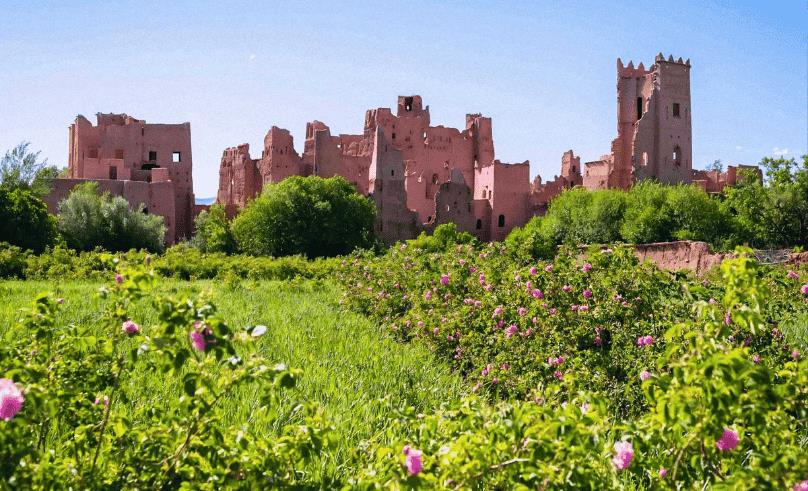
If there is one time to visit Kalaat M'Gouna, it is between late April and mid-May, when the Valley of Roses comes briefly into bloom. For a few weeks each spring, the famous Damask roses transform the landscape, spilling soft pinks across fields, village gardens, and oasis plots before the annual harvest begins.
Set between Ouarzazate and Tinghir, Kalaat M'Gouna is often described as Morocco’s rose capital, though that title only tells part of the story. The town sits quietly within a wider tapestry of palm groves, orchards, kasbahs, and mountain valleys, where agriculture and daily life remain closely intertwined.
-a34cb24c-658e-4580-b0b0-82288938f839.png) In this season, the contrast is what stays with you. The surrounding Atlas foothills feel dry and sculpted, yet the valley floor softens into green strips of cultivation where roses grow alongside almond trees, pomegranate orchards, and vegetable plots. Nothing here feels like a plantation in the modern sense. It is a living mosaic, shaped by generations of small-scale farming.
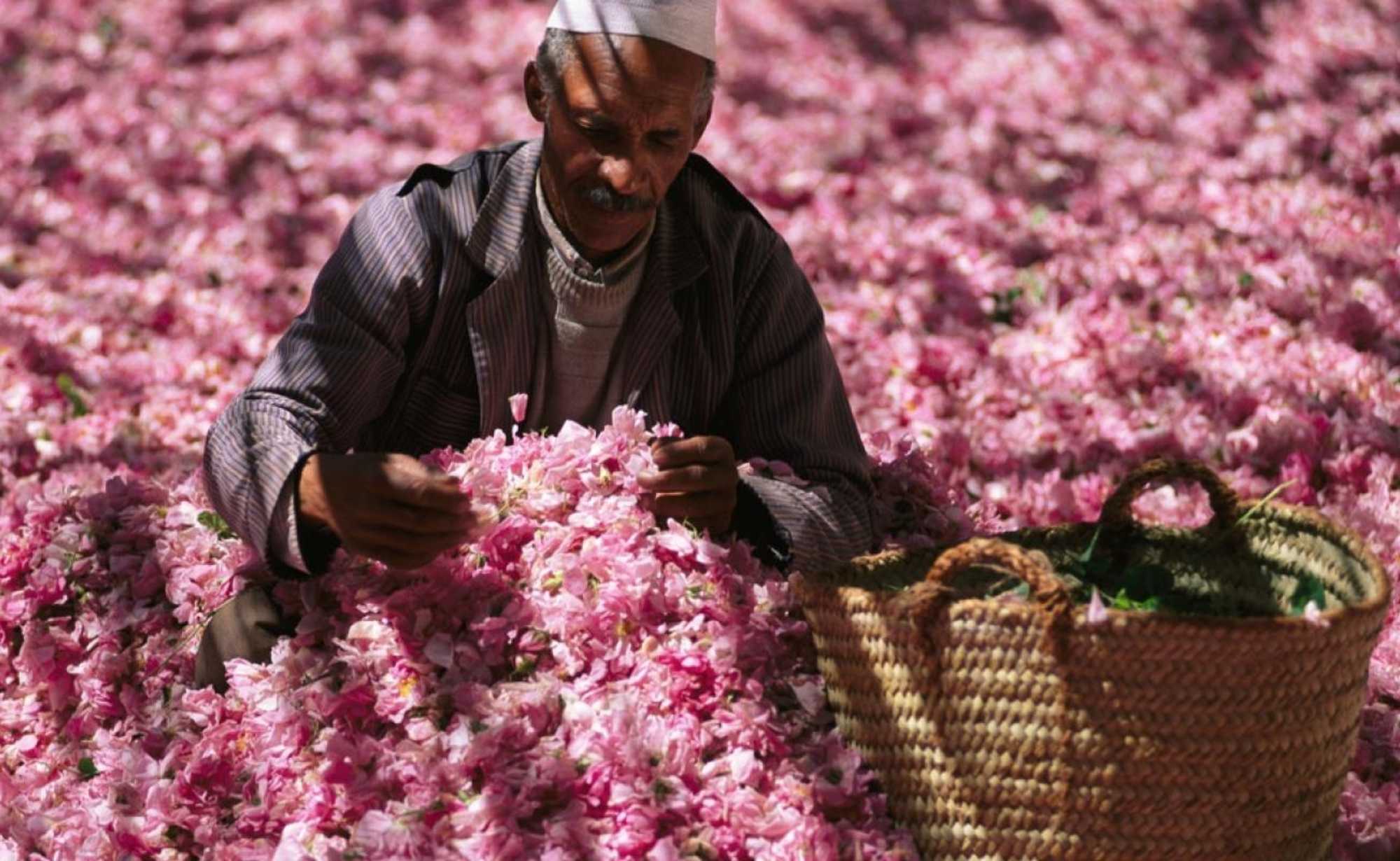
Early in the morning, just as the sun begins to colour the sky, local workers move through the fields by hand, gathering blossoms while the air is still cool and the scent at its most concentrated. It is also the best time to explore on foot, when the light is soft and the paths between villages remain quiet. Some guesthouses arrange guided walks through these rose-growing areas, offering a closer look at how deeply the flower is woven into daily life.
In this season, the contrast is what stays with you. The surrounding Atlas foothills feel dry and sculpted, yet the valley floor softens into green strips of cultivation where roses grow alongside almond trees, pomegranate orchards, and vegetable plots. Nothing here feels like a plantation in the modern sense. It is a living mosaic, shaped by generations of small-scale farming.
Early in the morning, just as the sun begins to colour the sky, local workers move through the fields by hand, gathering blossoms while the air is still cool and the scent at its most concentrated. It is also the best time to explore on foot, when the light is soft and the paths between villages remain quiet. Some guesthouses arrange guided walks through these rose-growing areas, offering a closer look at how deeply the flower is woven into daily life.
 As the season peaks, the valley gathers for the annual Rose Festival in May. What began as a local celebration of the harvest has grown into a regional event filling the streets with music, markets, and performances. Rose water, perfumes, soaps, and cosmetics appear everywhere, all derived from the same short-lived bloom. Traditional Amazigh music and Ahwash dance remain at the heart of the festival, anchoring the celebrations in the communities who have tended these fields for generations.
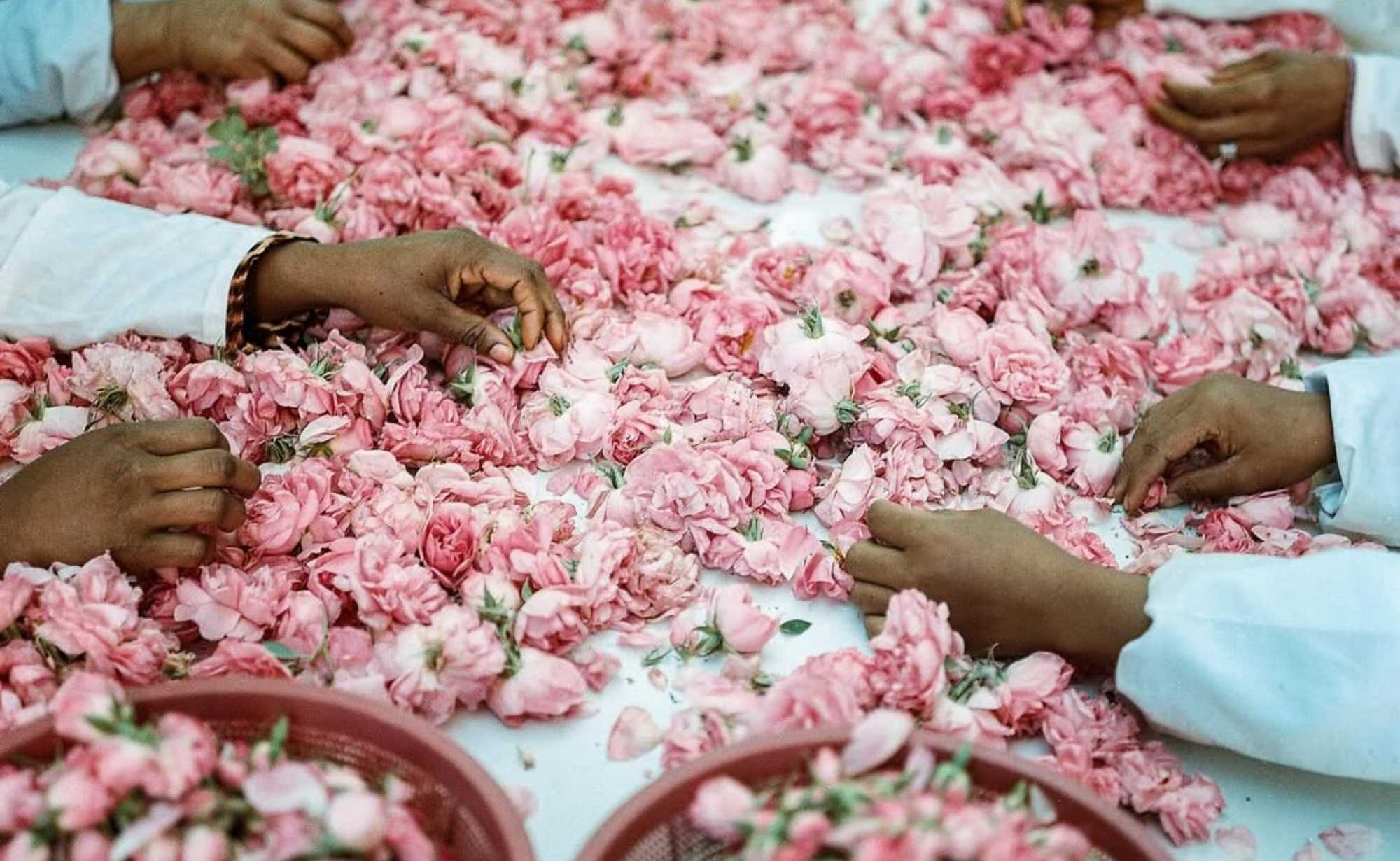
Beyond the festivities, the quieter story of the region unfolds in its cooperatives and distilleries. Here, petals are transformed into rose water, oils, and fragrances through a surprisingly labour-intensive process that requires vast quantities of flowers for even small yields. Visiting during harvest season offers a rare chance to see this work in motion and understand how a fleeting bloom sustains livelihoods long after it fades.
From Kalaat M'Gouna, the landscape opens outwards in every direction. A short drive leads into the Dadès Valley, where winding roads cut through dramatic rock formations and clusters of kasbahs appear along the way, remnants of old caravan routes that once connected the region. Further on, the terrain deepens into mountain country, where trails extend towards the M'Goun Massif and the higher reaches of the Atlas.
As the season peaks, the valley gathers for the annual Rose Festival in May. What began as a local celebration of the harvest has grown into a regional event filling the streets with music, markets, and performances. Rose water, perfumes, soaps, and cosmetics appear everywhere, all derived from the same short-lived bloom. Traditional Amazigh music and Ahwash dance remain at the heart of the festival, anchoring the celebrations in the communities who have tended these fields for generations.
Beyond the festivities, the quieter story of the region unfolds in its cooperatives and distilleries. Here, petals are transformed into rose water, oils, and fragrances through a surprisingly labour-intensive process that requires vast quantities of flowers for even small yields. Visiting during harvest season offers a rare chance to see this work in motion and understand how a fleeting bloom sustains livelihoods long after it fades.
From Kalaat M'Gouna, the landscape opens outwards in every direction. A short drive leads into the Dadès Valley, where winding roads cut through dramatic rock formations and clusters of kasbahs appear along the way, remnants of old caravan routes that once connected the region. Further on, the terrain deepens into mountain country, where trails extend towards the M'Goun Massif and the higher reaches of the Atlas.
 Accommodation across the valley reflects this same sense of place. Traditional guesthouses and kasbah stays such as Kasbah Itran, Kasbah Roseville, and Kasbah Chems sit within the landscape rather than apart from it, often built in restored earthen architecture that mirrors the surrounding villages. Most travellers stay a few nights, long enough for the rhythm of the valley to settle in.
And yet, even after the roses fade, what lingers is not just the season itself but the way everything overlaps. Agriculture, culture, and landscape are not separate experiences but part of the same continuum. Petals dry in courtyards, markets continue to trade in rose-based products, and the scent of distillation drifts through certain corners of the town.
For those planning a spring journey through Morocco, this brief window between late April and mid-May is when Kalaat M'Gouna feels most alive. The roses bloom, the harvest begins, and the valley briefly becomes something both everyday and extraordinary at once.
Accommodation across the valley reflects this same sense of place. Traditional guesthouses and kasbah stays such as Kasbah Itran, Kasbah Roseville, and Kasbah Chems sit within the landscape rather than apart from it, often built in restored earthen architecture that mirrors the surrounding villages. Most travellers stay a few nights, long enough for the rhythm of the valley to settle in.
And yet, even after the roses fade, what lingers is not just the season itself but the way everything overlaps. Agriculture, culture, and landscape are not separate experiences but part of the same continuum. Petals dry in courtyards, markets continue to trade in rose-based products, and the scent of distillation drifts through certain corners of the town.
For those planning a spring journey through Morocco, this brief window between late April and mid-May is when Kalaat M'Gouna feels most alive. The roses bloom, the harvest begins, and the valley briefly becomes something both everyday and extraordinary at once.
- Previous Article This Palestinian Family Lives in an RV & Travels Across the US
- Next Article This Eco-Lodge in Siwa Was Built Inside Old Shali’s Walls