

Saya La Villa Is a Seven-Room Kaleidoscope in Beirut’s Mar Mikhael
In Beirut's Mar Mikhael, Saya La Villa fills with clashing colours, warm clutter, a sun-filled glasshouse, and seven rooms that each tell their own version of the city.

Mar Mikhael, a neighbourhood in the Lebanese capital of Beirut, has never quite settled into one identity, carrying a legacy of hardware stores and automobile shops that makes the day potter along at the pace of its own errands. Mechanics lean over open bonnets a few doors down from ateliers stacked with canvases, and grocers call out prices beneath balconies dripping in bougainvillea and forgotten laundry.
By night, the entire street rearranges itself into something else altogether, spilling over with the low hum of banter from bars that used to be print shops, restaurants that used to be garages, and galleries that used to be nothing much at all until somebody with vision and very little money decided otherwise.
-1401df26-a9ce-49ed-8c3e-bf4733a0be75.jpg) It’s a district built on reinvention, on industrial bones dressed up in creative clothing, and it has long been one of Beirut's most magnetic pockets for anybody who would rather stumble upon a city than be marched through it on a checklist. Right in the thick of this glorious contradiction sits Saya La Villa, a seven-room boutique hotel so unapologetically colourful and characterful that it feels like a place to be gently, joyfully unsettled.
It’s a district built on reinvention, on industrial bones dressed up in creative clothing, and it has long been one of Beirut's most magnetic pockets for anybody who would rather stumble upon a city than be marched through it on a checklist. Right in the thick of this glorious contradiction sits Saya La Villa, a seven-room boutique hotel so unapologetically colourful and characterful that it feels like a place to be gently, joyfully unsettled.
Housed inside an early 20th-century villa that’s clearly lived several lives before this one, Saya La Villa wears its history the way Mar Mikhael wears its own, which is to say loosely, playfully, and without any interest in pretending to be tidy. Its soaring ceilings carry a sense of visual mischief that seems to delight in surprising you around every textured corner and coloured crevice of little rhyme or reason.
-b49d5686-fd6b-4ef2-8ff9-f2d0f2e6b99a.jpg) There’s no use in trying to piece together a script, so you lean into the warmth and listen to what each room has to say, reckoning with statues that arrived with reverence rather than demand. A brass lamp sits beside a chipped ceramic jug that’s seen better days, a pairing that inherited the same eccentric taste of clashing patterns and hues that somehow cohere into something that feels entirely, confidently itself.
There’s no use in trying to piece together a script, so you lean into the warmth and listen to what each room has to say, reckoning with statues that arrived with reverence rather than demand. A brass lamp sits beside a chipped ceramic jug that’s seen better days, a pairing that inherited the same eccentric taste of clashing patterns and hues that somehow cohere into something that feels entirely, confidently itself.
By the time you’ve made your way from the entrance to your room, you finally understand that you’ve been wandering through cluttered memories of Lebanese households long gone, ones with mismatched chairs that nobody ever got around to replacing because why would they, when they already had their own stories to tell.
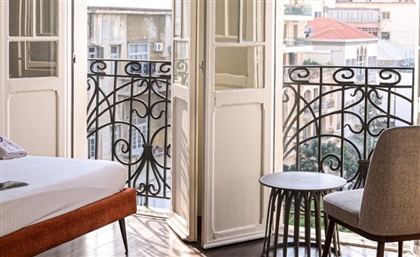
-1e3d48b3-624a-4752-b4b5-73647e1a9839.jpg) The seven rooms are where that spirit really gets to stretch its legs, since no two have been asked to match. Each one reads like its own short story, with its own palette, its own textures, its own particular mood, so that choosing where you lay your head for the night feels like choosing a version of Beirut you’d like to wake up within.
The seven rooms are where that spirit really gets to stretch its legs, since no two have been asked to match. Each one reads like its own short story, with its own palette, its own textures, its own particular mood, so that choosing where you lay your head for the night feels like choosing a version of Beirut you’d like to wake up within.
The junior suites and superior rooms lean into bolder, more saturated colour, the kind that makes a headboard feel like a small act of rebellion, while the double rooms settle into something softer and more contemplative, letting light and craftsmanship do the talking instead. What ties them together is a shared sensibility, a willingness to be a little theatrical, a little tactile, a little unexpected, and never boring.
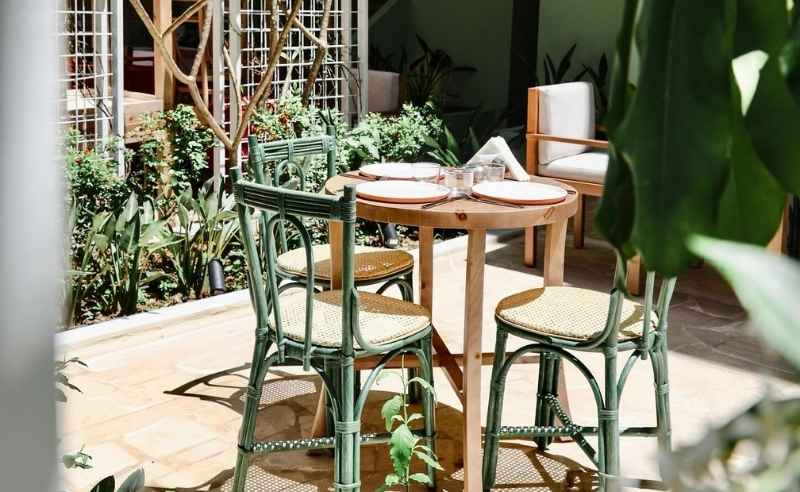
-4e904ca6-78da-4194-9030-b85954927800.jpg) Once you step outside, the villa reveals another side of itself entirely, because for all its indoor exuberance, it also understands the restorative power of a green haven in a capital that barely cares to offer much of it. The front garden unfolds with a soft exhale offering a shaded, plant-filled pocket where coffee goes cold without anyone minding; plastic worries left somewhere back at the front gate along with your shoes, perhaps, while cats slip between table legs and the neighbourhood's noise softens into something closer to hum than clatter.
Once you step outside, the villa reveals another side of itself entirely, because for all its indoor exuberance, it also understands the restorative power of a green haven in a capital that barely cares to offer much of it. The front garden unfolds with a soft exhale offering a shaded, plant-filled pocket where coffee goes cold without anyone minding; plastic worries left somewhere back at the front gate along with your shoes, perhaps, while cats slip between table legs and the neighbourhood's noise softens into something closer to hum than clatter.
Then there’s the glasshouse, arguably the villa's most theatrical flourish, a sun-warmed, light-flooded space that practically begs to be filled with an aperitif and a small crowd. Whether you stumble there for a solitary read or for the kind of golden-hour gathering that turns strangers into friends by the second round, the glasshouse captures the villa’s philosophy of shared hospitality.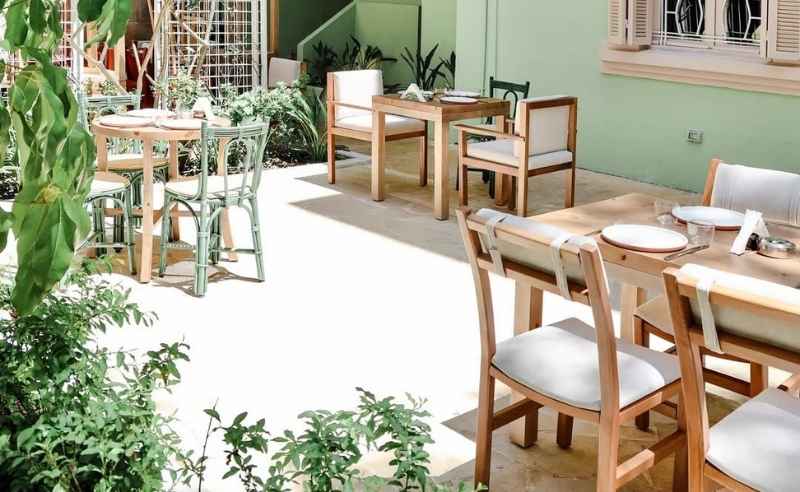 For a first-time visitor to Beirut, staying here means being dropped straight into the city's most creatively charged corner without having to negotiate taxis or timing, while for a returning guest, it offers the rare comfort of a base that feels as textured and alive as the streets surrounding it. The team, for their part, seem well versed in playing local guide too, happy to point a curious guest towards the right table for dinner or the right gallery to duck into before the sun gets too low.
In a neighbourhood built entirely on the art of becoming something new, Saya La Villa has simply done what Mar Mikhael does best: taken an old structure with good bones and filled it with enough imagination, warmth and audacity to make it impossible to forget.